2013, Sahalie Publishing

2013, Sahalie Publishing
256 pages, over 100 pictures

Limited edition...

The Brass Bell can be purchased online at Sahalie Publishing and Amazon.com.


Thursday, March 24, 2011

The Mother's Club


The Importance of Parent Participation


There's been a lot of chatter in the news lately about who is responsible for a child's success in the classroom. There is a movement gaining momentum across the country that places the blame of failing students squarely on the shoulders of classroom teachers.

Part of the success story of Cherry Road School was parent and community involvement. Marion Parsons formed The Mother's Club in 1929. These women played a key role in letting kids know that their family was part of the school and the school was part of the community. They helped raise money every year for the annual 8th grade trip by serving covered dish lunches in the new school cafeteria. The mothers were an important cog in the wheel that made the school go 'round.

My Aunt Wilma Cole recently sent me an article dated February 2, 1935 from the Syracuse Post Standard. The headline reads: Pupils Honor Mothers at Hobby Show. You can tell that the article held a prominent position in the paper, with a multiple column picture featuring my Aunt Helen Cole and Jacqueline Gallagher.

Calling the event one of the school's gala events of the year, it is described in the article as a combination pet show, hobby show, doll show, and exhibit of cooking and sewing, toys, art, and foreign articles. In the picture, my aunt is holding a cake she has made and for which she won a prize. Jacqueline holds a prize-winning doll entered by Jean Stone. Other prizes in the the doll section went to Pollyann Schwartz; Donald Cole and Donald Beagle won prizes in the toy category. Prizes for drawing were awarded to Billy Dwyer and Donald Crawford. (My Aunt Helen is 14 years-old in the picture. She died this year in her late 80s, as did Donald Cole.)

The hobby show was held in the gym/auditorium and was meant to help raise money for the Mother's Club and to honor their participation in the school. One can tell how sincerely the kids were engaged in the event by the long list of students on the organizing committee, boys and girls alike.

If a student was failing or in trouble, it was an issue for everyone and blame for no one in particular. Mostly the children of Cherry Road School worked hard to do well and honor adults who were part of the larger community. They had a sense that these were people who cared. So they honored The Mother's Club every year and did their best in school. (Not that they didn't have fun and try to get away with things once in a while....they did, and those are some of the most heartwarming stories of all.)

This picture of Miss Parsons and some of the early CRS teachers would have been taken around the time of the newspaper article.

Sunday, February 27, 2011

Did You Know?

Cherry Road School Grew and Grew

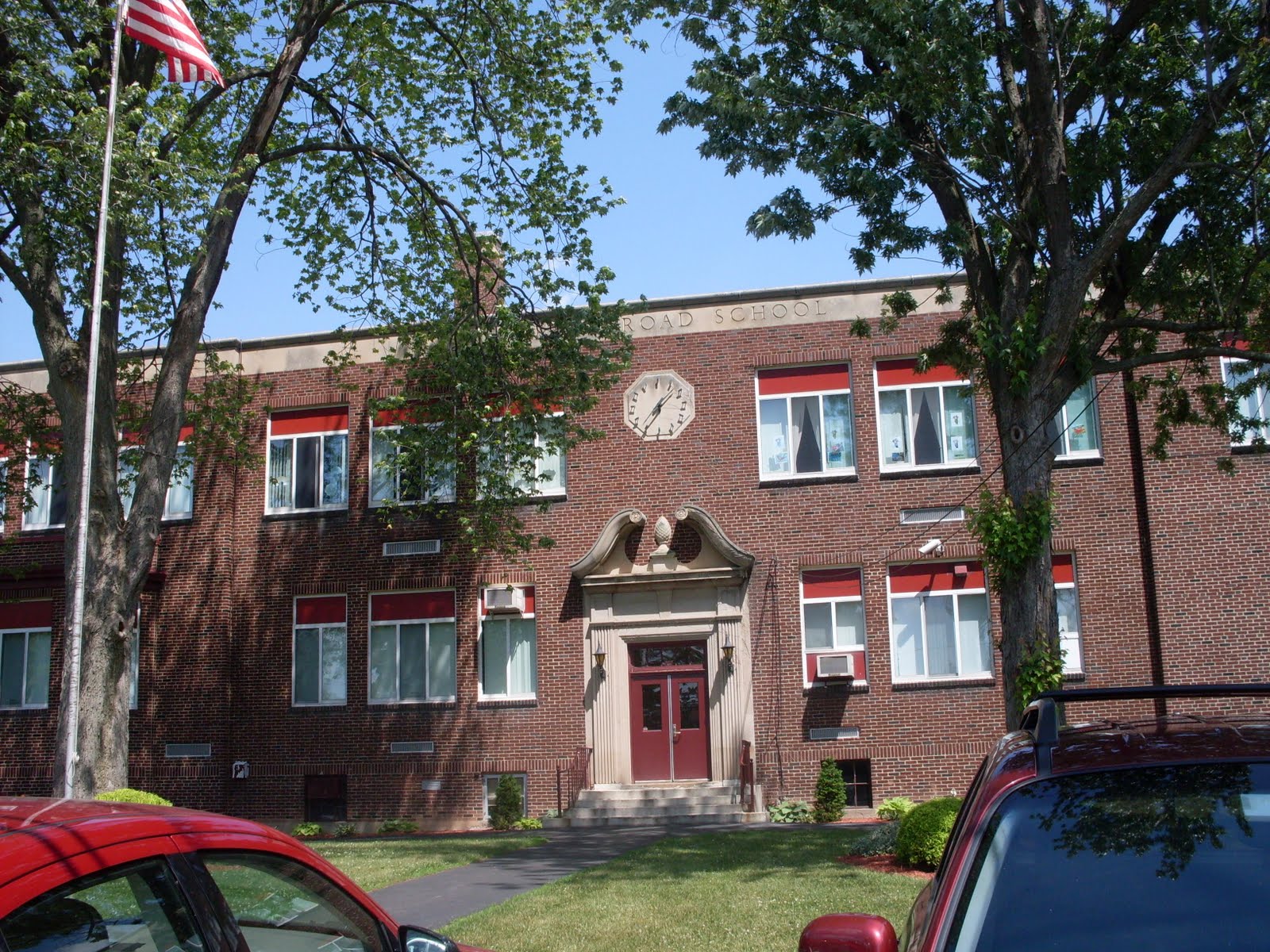
Did you know that Cherry Road School has undergone construction at least eight times? The original building that consisted of two classrooms (rooms 104 and 108) and an office was constructed in 1926. Classes did not begin in this building, however, until at least 1927 when room 103 was completed.

Students met in a refurbished farm building, the Parsons' parlor, and the Parsons' barn while construction was underway. There is some conflicting information about dates. However, I have spoken with at least two of the people who began first grade in the refurbished chicken coop and because of their birthdates, and because this is how they remember it, it would have had to be at least 1927.

In 1928, room 105 was completed, and then in 1930, room 110 and the gym were added on to the growing structure made of fire-proof bricks. Eleven years later, in 1941, a second floor went up and included rooms 202, 204, 206, 210, and a girls' lavatory. Five years later rooms 203, 205 and 209 and a boys lavatory were added.

A few years passed, the school grew in numbers, and in 1949, the cafeteria along with six classrooms were built. This addition included rooms 111, 112, 113, 114, 115, and 116.

Another addition, including a playground and six classrooms, was completed just before my class started kindergarten in 1953. These classrooms were on the second floor: 213, 214, 215, 216, 217, and 218. Of note, this was also the year my Great Aunt Marion, Miss Parsons, retired.

Miss Parsons and a fellow teacher are shown on the front step in the picture above.

Wednesday, February 9, 2011

Seeking Guest Bloggers!

Would you like to be a Guest Blogger on the Cherry Road School book project blog? Do you have a story to tell about the olden days? About the not-so-olden days? Whether you graduated from Cherry Road School in 1935, 1955, or 1995, please feel welcome to share a story of your days at this unique neighborhood school.

For more information, contact the blog host at:

schoolhouse2@comcast.net (put CRS Blog in the subject line)

Wednesday, February 2, 2011

Remembering Cherry Road School


Cherry Road School Song


Do you remember the Alma Mater song written by John Garofalo and sung to the tune of America the Beautiful?

Surrounded by the hills and dales
Beneath fair skies of blue
In Westavle, stands our school, that's been
To all of us so true.

We came to thee in infancy
For knowledge, love and truth
We learned in school - "the Golden Rule"
To carry on through youth.

And when in life, we reach our goal
We'll ask the Lord to bless
Our Alma Mater - that to ous
Has brought such happiness.

Oh, Cherry Road, we'll honor thee
As swift years hurry by
Our love for thee - eternally
Is one that shall not die.

Monday, January 24, 2011

Remembering Westvale


The Importance of Community


One of the things that bothers me about so-called school reform measures today is that teachers shoulder so much of the blame. Having listened to the stories of Cherry Road School alumni now for several years, it's clear that what they remember is not how they did on the test, not what they learned in the class, but the magic of the community of which they were part. It was for their membership in this community they tried their hardest in school and on the playing field. What they did they did to please and impress not only their teachers, but also their parents, the Mother's Club, and their peers. I say peers because if one student did not do well, it reflected poorly on all the students. Why? Because they were part of a community whose very framework depended upon the participation of everyone. These are the lessons they learned that helped each and every one succeed in the lives that followed their days at Cherry Road School.

Some of you might recognize the picture above of McArdell's Gas Station, a landmark in Westvale on the corner of West Genesee Street and Maple Road. I used to go there with my dad. He'd meet up with his high school buddies and I'd drink grape and orange sodas from the Ne Hi machine. See the little room up at the top of the building? A guy named Hank lived up there for a while after the war. He may have been Japanese. One day he came and lived at our house, just a few doors up the highway. He never spoke a word to me and I just assumed he didn't speak English. Instead, he'd open his bedroom door a crack and shove a piece of double bubble gum into the palm of my hand and close the door again laughing. I found out later he was a graduate student and spoke very good English.

I'll never forget my days in Westvale and I'm learning from my interviews that this holds true for everyone who has lived in this odd little community with no Main Street. Instead of a Main Street with a soda fountain and a five and dime, Cherry Road School, in many ways, served as the heart of the community. There were other institutions that were part of the Main drag of Westvale, spread out over many blocks and neighborhoods. There was Lundy's Drive-In where they brought bright silver trays to attach to the side of your car window and served the best hamburgers and chocolate shakes on the planet; McArdell's Gas Station was a club house for high school boys in the way these grease joints were. The movie theater was a place to go on Saturdays. The owners sold candy to the kids on the cheap and then hustled upstairs and ran the film. The school was always open on a Saturday, all seasons of the year, for a pick-up game of basketball in the gym or baseball out on the rolling campus of green grass and pine trees. Sledding on the reservoir in wintertime holds a story for everyone. Westvale made an impression so deep on each and every student that none of them ever forgot to live up to the expectations that were a reflection of the surrounding community.

How sad that our national education leaders have now put the burden on the shoulders of individual teachers. A new organization called Students First, the brainchild of the woman who recently, as the the superintendent of schools in Washington, DC, fired 200+ teachers because their students were failing. She proposes closing community schools instead of supporting these communities so they might do better. She suggests that parents should be able to choose schools that are doing a good job, rather than bolstering schools in their own neighborhoods with investments of time and attention.

What do you think?

Sunday, January 2, 2011

Primary Source Documents


Letters from Papa

In this picture you see Willis Parsons examining ripe apples in his orchard. The picture would have been taken sometime in the early 1920s, somewhere between Parsons Drive and Maple Road to the east and west, and Genesee Street and Salsibury Road, to the north and south...Perhaps he is in the backyard of the family farmhouse on the corner of West Genesee and Parsons Drive. Of course, in those days, roads like Parsons Drive and the others mentioned here were, for the most part, nothing but dirt farm roads.

This past fall, while I was visiting, my cousin generously gave me original copies of letters written in 1924 and 1925 by Willis to Marion while she was teaching in Omak, Washington. The letters came from my cousin's mother, my Aunt Helen, Willis's granddaughter and Marion's neice. Helen died in October while I was there; these letters were in her effects. Included in the letters was a missive written by Helen to Aunt Martha, Marion's sister, in 1935.

Reading Willis's letters one gets a feel of what life was like on the farm before the farm became a neighborhood and a school. One begins to sense emerging feelings of unease about the viability of the farm as a sustainable business. He talks about picking cherries in the rain and the picking lasting almost a month; they were badly in need of hot weather and if he put some of his crop in cold storage, he might be able to hold on for better prices the following year. He indicates a growing interest in the real estate business. One can almost feel the wheels turning in his mind; perhaps the only salvation he sees is to sell off the farm. He would have to make that sacrifice mean something. He would have to create a community. At this time, he has already begun to plan the new school with Judge Terziev and others in the area who had already bought into the Parsons' acreage.

For a writer of narrative non-fiction, these letters are gold. They help those of us here in the future understand, or at least glimpse, the thinking processes and problems of those in the past who took their stories with them to the grave.

In Helen's letter written in 1935 she talks about a horrific rain storm, about spending the night at Grandma Harkness's with Ruth and Janet Parsons. These are names I hadn't heard since childhood. Genealogy records show Grandma Harkness to be part of the Terry and Parsons family who had donated the original one-room school on Terry Road.

Writing The Brass Bell has been 75% detective work, and 25% writing.

If anyone has any information about Grandma Harkness, Guy Terry Parsons, Sr., Charles Herbert Parsons, or Alice "Allie" Terry, please contact me: schoolhouse2@comcast.net

I still have a ways to go before I am able to untangle the web of the Parsons, Jerome, Schuyler, and Terry families, from whose farms sprung what is today Westvale, and from whose vision gave rise to the Cherry Road School.

Monday, December 27, 2010

Solvay-Geddes Historical Society Hosts CRS Alums


A Meeting of Old Friends

Last October, the Solvay-Geddes Historical Society hosted a panel of Cherry Road School alums, distinguished guests who graduated from Cherry Road School in the 30s, 40s, and 50s, but still remember fondly their days at the little brick school.

If you would like to see a slideshow of pictures from that meeting, please left-click on this link: Photobucket.

One of the amazing elements of the Cherry Road School story is the enthusiasm with which people who exited through its distinctive double doors, some as many as 65 years ago, recall their days there. Many convene regularly to maintain friendships and recall Mother's Club lunches in the cafeteria, senior trips to NYC, or the excitement of being called to Miss Parsons' office. It was these small yet significant experiences and a life lived in a close-knit community that taught them the meaning of mutual respect, integrity, and responsibility, say many of the alums.

These are the same lessons we long for students to learn today. Unfortunately, there is a lack of leadership to ensure a cohesive team of teachers, the support of community, and the kind of parent involvement that existed for Cherry Road School students. I believe it is these elements, rather than fleeting standardized test scores, that will help guarantee present and future success for youngsters who are today distracted by too much media and too few consistent guidelines to be held to on a day-to-day basis.

The book in progress, The Brass Bell, will explore how strong leadership and community involvement successfully guided a small school in a cherry orchard through rough economic and social times. It will examine why the imprint of the experience is still fresh on the minds of alumni who may now be in their seventies and eighties.

Thursday, December 2, 2010

Schooling, Past & Future


Terry Road School Students, circa 1917


As followers of this blog know, work is progressing on a book, The Brass Bell. The book will follow the history of Cherry Road School and the life of Miss Marion Parsons, the Parsons Family, and the community of Westvale. Before there was Cherry Road School, students in this tiny farming community (now part of the greater city of Syracuse) attended the Terry Road School. That property and building was donated to Geddes School District 1 by Guy Terry Parsons and was located less than a mile to the west of Cherry Road School. Marion Parsons, her sisters, Grace and Martha, their cousins, the Jeromes, the Terrys, the Schuylers and other families who still reside in Westvale, all attended the Terry Road School until it became too small and too drafty and outdated to serve the needs of the community.

Cherry Road School replaced Terry Road School in 1926. There was a period of time before the new school opened when many community members opened their parlors and their kitchens for classes. School was always at the top of the list of priorities in this community. The book,
The Brass Bell, will explore some questions whose answers might inspire and inform educators today who seem lost in the argument about how to make school relevant for students who are failing and floundering in the public school system. Following are some examples of some of those questions.

If you have any thoughts, opinions, or ideas related to these questions, please post a comment. If you would like to be a guest blogger and have your article or story appear here in this blog, please contact me at the email address at the end of this post.

Here are some of the questions explored in The Brass Bell:

1. If the basis of effective schooling must constantly change with changes taking place in economic and social structures around us, how will we ever settle once and for all on effective school reform?

2. How did one small community, surrounded but never engulfed by a city, make use of the best of who they were and what they had to create a school whose original students, and those who attended throughout the years, view their experience at Cherry Road School as the best of their lives?

3. In what ways do the values and the methodologies of the one room school set examples from which schools today might learn and benefit?

4. What can be learned from the life and the successes of one educator who led one school through The Great Depression and World War II?

5. What was it about Cherry Road School that draws grown men and women who’ve lived their lives successfully to keep coming back, coming together, to talk about their days there and in the community of Westvale? People who graduated in the 30s, 40s, and 50s meet regularly to talk about Cherry Road School, Miss Parsons and the other wonderful teachers who helped shape their lives.

Contact me at: schoolhouse2@comcast.net and please put "Cherry Road School project" in the subject line of your email.

Thursday, November 18, 2010

Leadership


What Makes a Successful School?


This is a question on the lips of educators, politicians, journalists, and parents today.

The answer is not one word, but one of the key elements of success is Leadership. Without the strong leadership of Miss Marion Parsons, the original Board of Trustees, and every teacher carefully hand-picked by Miss Parsons, Cherry Road School would not have survived, would never have become the pivotal experience in the thousands of lives that have been positively affected by their experiences in this school and by the example set by Miss Parsons, from 1926 through today.

In the picture you see Miss Parsons rowing the boat. She lived her life as a fearless and thoughtful leader. It was her leadership that guided a small school launched in a hen house to the lighthouse it became for all who passed through its memorable brick doors after construction was completed in 1926. Miss Parsons had the gift of leadership. As her long-time secretary, Helen Wright commented, "In the 25 years of her leadership, she never made an enemy."

In the picture above, from left to right: Cousin Bertha, Grace Parsons Cole, Marion Parsons rowing the boat, and Martha Parsons.

'Ten geographers who think the world is flat will tend to reinforce each others errors….Only a sailor can set them straight'. John Ralston Saul, 'Voltaire's Bastards'.

Sunday, November 7, 2010

Remembrances

Remembering Marion Parsons

At the recent Panel Discussion sponsored by the Solvay-Geddes Historical Society, we talked about remembrances of Miss Marion Parsons, Cherry Road School, and Westvale. Panel members each shared one special memory about the woman, the school, or the community. Not wanting to take up time with my own story that evening, I'll share it now.

We lived with my Aunt Marion when I was a baby until I was old enough to walk. As memories come into focus about the beginning of my life, I remember her coming home in the afternoon from the school, just two doors away. Always jolly. Always happy to see me, in my version of history. She would sit in her big rocking chair and hold me on her lap. I’d nestle my head into her shoulder, listen to the hum of her hearing aid. We would rock and rock. The creak of the rocking chair kept a constant rhythm and beat to the stories about the olden days, the old clock on the mantle. When I was a little girl, she would say, my father would hitch up the horse and buggie. These stories about the olden days came to be known to the two of us as "stories out of her think." I must have slept. She must have slept, too, during these afternoons in the chair, to the creak of the rocker, lulling us both into a dream-state. I would imagine myself riding with Marion, my grandmother and Aunt Martha in the rumbling buggy down the dirt road, through the potato field and on to the cherry orchard. Men and women would be working throughout the orchard, ladders extended into trees, wagons filled with boxes of fruit.

After we had slumbered and drifted through the olden days, after Marion had rested from her day at school, she would let me ride on her foot—a pretend ride on a horse to Banberry Cross, ride a horse, ride a horse.

I don’t remember her ever being cross with me. Her face always lit up when she came into the room. I would run to her. She would hold me and give me the love I craved from her. Until one day.

Each morning I would watch her put the braces onto her legs and then trudge across the lawn toward the schoolyard. I’d watch until she was out of sight. On this particular day, I must have been old enough to follow her, three or so, because after a while I followed her to the school and found my way to her office.

Expecting her to be thrilled to see me and proud of my resourcefulness, I ran straight into her office and stopped short of her towering desk. A dark cloud I had never seen or imagined descended across her face. Her voice shot across the desk in a tone I had never heard.

“What in heavens name are you doing? How did you get here?” She grabbed my hand, pulled me toward the door, gently, yet firmly, in an unfamiliar gesture. My first and my last scolding from my Aunt. I never crossed her again. Instead, from that day on, I thought things through first when it came to Aunt Marion. She was the one person in the world I didn’t want to let down.

By the time we got back to the house, it was my mother for whom Marion had words. I stood back and listened to the rebuke, terrified. Marion turned to me on her way out the door, bent down, and gave me one of those hugs I’ll never forget, the smell of her talcum powder, the tear in the corner of her eye let me know that she had suffered more from the scolding than I.


Picture: The baby is me, being held by my mother. That's Marion on the right, and my Grandmother, Grace, in the background. Our family was big on Sunday afternoon get-togethers. I believe this was a tradition brought forward from many generations in the past and shared by other Westvale neighbors.

Thursday, October 28, 2010

Halloween at Cherry Road School


The First Halloween at Cherry Road School!


Halloween is a few days away. It was my one of my Aunt Marion Parsons' favorite holidays. She loved everything about it.

Here is a picture of the first Cherry Roaders, 1927, "all fixed for Halloween!" The caption is written by Marion Parsons, a doting auntie, teacher and principal. (During the first few years, she served both as teacher and principal.)

That's my father, the baby on the ground; the two children reaching to him are my Uncle David and Aunt Helen who were twins. (They both passed this year.)

The picture was taken in their backyard at 107 Cherry Road.

Friday, October 22, 2010

Miss Parsons


Reflections on Miss Parsons:

After talking to so many alumni and former teachers of Cherry Road School while visiting in New York this month, I came home with core themes, common to everyone who remembers Miss Parsons through their own experiences. These themes include "respect" and "common sense."

One former student who graduated 8th grade at Cherry Road in 1943 put it this way:

An awful lot of common sense--that's how she educated. She didn't have any hard-set rules. Back then, when you were principal, you called the shots. To my knowledge, she always called it right.

Tonight, while rifling through my research artifacts, I came upon the program for Marion's retirement luncheon, put on by the Mother's Club of Cherry Road School. The opening page reads:

With deep affection and gratitude.....The Mother's Club of Cherry Road School joins with the community of Westvale to present this testimonial luncheon in honor of Miss Marion Parsons, who for twenty-six years has been principal of Cherry Road School.

Friend, confidante, and inspiration to countless children, Miss Parsons has served the community in more than a professional way. She is our well loved neighbor and friend.

Keeping constantly abreast of the latest trends in education, she has kept the standards of Cherry Road School high, giving our children fine instruction coupled with a happy school experience.

The founder of the Mother's Club in 1927, she has been its inspiration and staunch supporter throughout its years of service, working with the mothers of our community towards the betterment of our school and closer parent-teacher relationships.

All of Westvale salutes Miss Marion Parsons--a gallant lady. We wish her much success and happiness in her retirement as she has given those whom she has served over the years.
May 24, 1952

Monday, October 18, 2010

Successful Syracuse Visit


Home Again, Home Again...

Hard to believe the long-awaited visit to Syracuse from my perch in Portland has come and gone. It was rush, rush to get there and be ready for the Historical Society presentation. My heart raced all day the day of and then it was over and people were raving about how interesting it was. Indeed, how often do you get to listen to oral histories told as though the pranks and the good times and the paper routes were just last week instead of seventy-some years ago and more? The twinkle in the eye of a man who has long retired from a bank job is the precursor to a good story and a life well-lived and not forgotten. So my research visit was off to a good start.

I stayed in an ancient Victorian farmhouse, once the target for everyone in the Marcellus-Skaneateles area in search of apples in the fall. Now the owners are struggling to restore the house, to find the history destroyed in a fire. That setting staged my visit. I woke up early each morning with a list of appointments and interviews and obligations. Clearly I overbooked my time, but it was worth every exhausting day.

I've returned to the office with hours of conversations to listen to on the digital recorder, copies of ancient pictures and newsletters, memories of times spent with cousins I've learned to appreciate. So much fodder for the story. I found an album I thought I'd lost. My cousin uncovered letters written to Marion Parsons by our Great Grandfather during a time she had gone west, during a time he thought she might not return to Westvale.

Since returning to Portland I've read and re-read the letters and have come to the conclusion that Willis was treading lightly with Marion in these letters. He dare not demand, yet held her interest and involvement with newsy letters, filled with stories of home that must have pulled at her heart and the ties that bind one to home. In a letter dated Sept 13, 1924, Willis Parsons writes: This has been a week of almost continuous rain bad for the State Fair as well as for farming. Sowed six acres of winter wheat yesterday and have five more to sow when the ground gets dry. Got the seed wheat (Junior No. 6) from a Mr Joroleman who lives on the Weedsport-Cato road. This wheat took first prize at the State Fair. When I went to look at it, I took Mother Grace and the babies. Two young couples from Interlaken came to the Fair, and camped at the lower end of the orchard. This was the sixth time they had been here for the Fair and same camp.

(I'm guessing Grandpa made a little extra on the side at Fair time, renting out camping spots in his orchard. "Mother Grace" was Marion's sister, my grandmother, and "the babies" would have been the twins, my Uncle David and Aunt Helen. Helen died just two weeks ago and would have been 89 next month. David died earlier this year and I will miss them both more than I can find words to describe.)

Sunday, August 29, 2010

Solvay-Geddes Historical Society


Historical Society to Host
Cherry Road School Alumni


On September 29, 7:00 p.m., the Historical Society will host a Cherry Road School alumni panel, facilitated by the moderator of this blog. Panel alumni will represent the 1930s, 1940s, and 1950s.

They will share remembrances of their days at Cherry Road School, and will discuss questions such as: How was it that the little school, born in a chicken coop in Willis Parsons' cherry orchard, successfully held together a community struggling through The Great Depression? What were the ways that Miss Parsons was able to make the school relevant in a time of economic flux and social change? Are there lessons to be learned through the endurance of Cherry Road School for schools and communities today? What were the values of the farm days that remain relevant for students in 21st century classrooms?

Evidence of the impact and endurance of Cherry Road School are the hundreds of alumni, many in their 70s and 80s, who still meet regularly to share memories of what has become one of the most important times of their lives, and the woman who has become their first and most beloved hero and role model, Miss Marion Parsons.

The meeting will take place at the Geddes Town Hall in Solvay, N.Y. on the evening of the 29th.

The discussion will inform the book in progress: The Brass Bell.

The Historical Society is sponsoring work on the Cherry Road School history project. Founded in 2005, the mission of the Solvay-Geddes Historical Society is to collect preserve, and showcase historical artifacts of the area. Over the past five years, they have expanded their collection and their membership.

Wednesday, August 25, 2010

What is the book about?


The Brass Bell

In my last post I said that the book is about a community and a school. That's the surface of the book. The story is about the woman who led the school into the 20th century. It's a story about duty and loyalty. It's about a community's will to survive in the face of economic disaster that was about to rip the entire country to its core. At its heart, it's a story about how one woman's loyalty and courage inspired generations of students and saved a struggling farm community from extinction. Miss Parsons understood the importance of the values of the past and the importance of the innovations of the future. The brass bell represents the link between the two.

Sunday, August 8, 2010

The Book


The Brass Bell

For those of you who don't know, this blog is in support of a book project: The Brass Bell. This is the story of a hen house that grew to be one of the highest-regarded schools in New York State, Cherry Road School. It's about the woman, Miss Marion Parsons, who founded the little school in her father's cherry orchard. The Brass Bell is a story of a small farming community that grew to be a thriving Central New York suburb.

Marion's grandparents, Edwin Clark Parsons and Julia Armstrong Parsons were one of the early settlers and farmers in the area that came to be known as Westvale. Their youngest son, Willis, was a very successful fruit farmer and operated two farms on the old Genesee Turnpike. He was the president of the New York State Fruit Growers Association for many years. Marion Parsons, the middle of Willis's three daughters, followed in the footsteps of many generations of Parsons before her with her respect for and dedication to education.

All the Parsons children, and their cousins, the Jeromes, Armstrongs, Schuylers, and more, attended the Geddes District One School, otherwise known as the Terry Road School. When the one room schoolhouse could no longer hold the children or keep them warm during the frigid winters, the people of this farming community were wise enough to look into the future. They saw the beginning of the industrial revolution. They understood the importance of an education befitting the times.

These same community members, Judge Farnham, the Parsons brothers (Willis, Frances, Charles), The Jeromes, and others, joined forces and formed a board of trustees. Willis donated nine acres of Cherry Orchard; Judge Farnham led the charge to raise money to build the school. Marion, who would later be known to her students as Miss Parsons, enlisted the help of the women picking fruit in the orchard to help her clean up the chicken coop where classes would be held that first year while the brick school was being built. The first floor, the first edition of many was finished later that year, circa 1926.

Miss Parsons was presented with the brass bell from the old Terry Road School. Tears must have sprung to her eyes as she held the bell, high above her head to ring for the first time, the bell whose resounding clang had once signaled her and her cousins and friends to the long wooden benches in the tiny one-room schoolhouse. As she rang the bell for the first time, she may not have imagined that nearly 100 years later, Cherry Road School would be the alma mater of thousands who remember Miss Parsons as their first and greatest hero.

The Brass Bell will tell the story of how that came to be.

Monday, August 2, 2010

A Good Teacher

What Makes a Good Teacher?

A good teacher is formed over time in the memories of students. This is a conclusion that might be drawn from a collection of posts on the subject on a national Education Week blog: Walt Gardner's Reality Check. Last week, Walt, a 27-year education veteran from the Los Angeles Unified School District, entertained this question on the blog. He based the discussion on a recent event in Washington, DC. In July of this year, 241 teachers were fired for poor evaluations or lack of proper credentials. Another 737 teachers were put on notice that if they don't improve their teaching, they too could wind up on the street.

What is this evaluation based upon, you may ask. Well, in grades four through eight, 50 % is based on student growth on standardized tests. In other words, are they doing better on their test scores each year. If not, this teacher may not be a good teacher, according to this system.

Other variables considered on these evaluations were classroom performance, though the Chancellor from D.C. admitted, allegedly, that she did not know the numbers when it came to this distinction. And what is classroom performance? It might include classroom management skills or teacher popularity. The answer to that is not clear.

Mr. Gardner rues the idea that our classrooms have become "test preparation factories." So do I. Is it the teacher's fault if a child is failing? There are so many factors involved. And besides, what will the child remember from those standardized tests in 20, 30, even 50 years?

The numerous Cherry Road School alumni I've spoken with over the past two years agree that they hold Miss Parsons in their hearts and minds because she commanded respect. It also seems to have been clear to all of her students that she cared about them and about their education. Years later what people remember is the kind, yet firm, woman who they still strive to please, even though she's long gone.

Mr. Gardner put it this way: "...I've long believed hindsight is the fairest way of evaluating teachers....the influence of teachers doesn't show up until years after students graduate. With the passage of time and the insights of maturity, students are in a far better position to evaluate their teachers."

What do you think? Please feel free to post your opinions by clicking on the "Comment" button.

Tuesday, July 20, 2010

Miss Parsons


My Miss Parsons


As I mentioned earlier in this blog, I had no idea how much my Aunt Marion meant to so many other people until I began work on this project. While I always thought of her as my Aunt Marion, I've come to know her better as everyone's Miss Parsons.

The picture here is my fifth birthday party in the backyard of our house on Parsons Drive, the old family farmhouse where Marion and her sisters grew up. That's me hanging from my swing set; that's Marion standing guard.

Notice her corsage. She took my parties seriously, the hostess to all my neighborhood friends. Marion loved children. She took everything about us seriously, our education, our social life, happiness, and mostly our understanding of what it means to be a good person. How self-centered I was to think she belonged to me alone when she meant so much to so many.

Tuesday, July 13, 2010

Cherry Road Alums


Ties That Bind~

I recently met up with some Cherry Road School alumni who also live in Oregon. Everyone you see in this picture attended Cherry Road except one. I'm in the black jacket and the others found me through this blog. How amazing is that? They were all in the same fifth grade class and two of them are married and now they are all close, held together by fond old memories and new-found friendships.

Walt Sweyer (middle, red jacket) tells me he was not the best behaved student at Cherry Road. I think he's made up for it since. Everyone agrees there was something so special about their experience at Cherry Road School that it's a strong tie that pulls all the way from Oregon.

Sunday, June 20, 2010

A Time Gone Past


Cherry Road School
Teachers from the 1940s


Many of the wonderful educators who helped make Cherry Road School what it is today, who some of the older alumni remember fondly, are gone. Though they are no longer with us, we remember them as though it were yesterday. As I make progress with the book, The Brass Bell, I realize how nice it would be to have pictures of these teachers and stories from their teaching days. Here is a list of CRS teachers from the 1940s (some are still with us):

  • Helen Miller
  • Pauline Steinbeck
  • Tibby Muench Dumanian
  • Ruth Walti
  • Margaret Hannigan Francoeur
  • Elsie Bedwell Haskins (still alive and kicking!)
  • Beth Schermerhorn
  • Ann Robinson
  • Jean McLusky Miller
  • Mary Costello Kinnan
  • Lorna Richards
  • Sallie Schwartz
  • Florence Wallace
If any readers/followers of this blog have pictures/stories about these educators you'd be willing to share for the book, please fell free to contact me: schoolhouse2@comcast.net

Though I do have several pictures of teachers from the olden days, I want to be sure I have a picture of each one and at least one story about how she (notice they are all "she") may have affected someone's life. Or, if for someone on this list who is still alive, if you have contact information I would love to speak with her. I have had a recent conversation with Elsie Haskins.

I appreciate the help and support I receive on this project. I plan to be in Syracuse in late September and early October this year.

Sunday, June 13, 2010

Learning Backwards


The Power of Life Experiences

I heard someone say something the other day and the truth of the statement took my breath away. "Life can only be understood backwards and yet it must be lived forwards."

Thanks to the power of the Internet, I've been making contact with more and more Cherry Road School Alumni. There are many commonalities in what they remember about those days. The most common denominator is how much Miss Parsons touched their lives in one way or another. One remembers conversations on the porch when he delivered her newspaper, another remembers personal tutoring because she was "not a good student," another how much she wanted to please her, and all remember Miss Parsons as a larger than life character in the story of their childhood.

Recently I met with someone who would have graduated from Cherry Road School around 1953. He said he received much more from the school than he ever gave back, and that he was unable to appreciate it at the time. He's thankful to have the opportunity now to give back if only by sharing his memories as a contribution to the book. I have to agree with Walt. If I had even five minutes with my Aunt Marion I'd thank her for all she did for me. I'd let her know that I've discovered in this work that she was that much to many others too. But since I can't do that, I'll have to thank her by completing the book that tells the story of the farm, the family, and the many futures that were touched. Fifty, sixty, even seventy years later, many understand what one person contributed so that we might flourish and remember our days in the brick building in the old Parsons' cherry orchard.

Wednesday, June 9, 2010

Heros


To be hopeful in bad times is not just foolishly romantic. It is based on the fact that human history is a history not only of cruelty but also of compassion, sacrifice, courage, kindness. What we choose to emphasize in this complex history will determine our lives. If we see only the worst, it destroys our capacity to do something.

Howard Zinn, the late historian


Westvale, the home of Cherry Road School, was born in bad times from the compassion, sacrifice, courage, and kindness of a farming community who saw the value of its youth and the importance of education. They saw the best in what they had and did something to ensure the future.


Sunday, May 30, 2010


In the Beginning


The little chair came from the original Cherry Road School. In 1925, Marion Parsons, with the aid of two women working in her father's cherry orchard, transformed an old farm building, a chicken coop, into a temporary classroom. With money raised by the first school board (Trustees) headed by Judge Farnham, a two-room building was constructed on the current location the following year. By 1926, the number of students grew from 11 to 50.

The nine-acre tract belonged to her father, Willis Parsons. It was a sprawling and beautiful cherry orchard where Marion had played as a child, and where the new school was built of cinder blocks, steel, and bricks. Soon the cherry orchard was a playground for the children of the growing neighborhood. Pieces of the farm were sold during The Depression, lot by lot, tract by tract, and over time, a neighborhood was born.

Ten years later, there were close to 300 K-8 students at Cherry Road School. Over the years the little school grew in size and in stature. There have been eight additions to the original building, a new gym/cafeteria in the 1930s, a new wing in 1947; in 1953, 21 classrooms were added and a formal playground installed. By 1957 there were 800 students. As time passed, the district reorganized the school. Teachers from the olden days retired, moved on. Marion retired in 1952. But there are many Cherry Road alumni who remember those times. They remember Miss Parsons, a most unforgettable person; they remember the extraordinary teachers who made a difference in their lives.

The book in progress, The Brass Bell, will keep Marion Parsons, and the teachers who worked by her side, alive for the students who spend their days in the slightly more modern chairs at Cherry Road School.

Sunday, May 9, 2010

A Tribute to my Uncle David Cole

I'd like to dedicate this blog to my Uncle David Cole. He was the Nephew of Miss Marion Parsons, my father's older brother, and my hero. My father and his older twin siblings, David and Helen, grew up in this house on Cherry Road, just two doors away from Cherry Road School. When they were kids, it was just their house, the school, and a couple of other houses on Cherry Road. After all, it hadn't been that long ago that Cherry Road was simply the cherry orchard, part of my great grandfather's 60-some acre farm that took up the area from Parsons Drive to Maple Drive and down way past what is now Cherry Road School.

My Uncle David died on February 22. Why was he my hero? I can't tell you specifically, in a word. He was a hero in my life because he let me know that he loved me. He showed up at moments and times that mattered. Like all of us, he wasn't perfect, but the things he did that were good left lasting impressions on the lives he touched. He was the principal of an elementary school, like his beloved Aunt Marion. To many, that's not such a big deal. He didn't ever make a million dollars and he didn't write a best-seller, but he touched a good many lives and he left his mark on the world. He did the right thing. He followed in the footsteps of the person whom he knew he could trust to set the best example.

Many years ago I wrote him a letter and asked him to share memories about Aunt Marion. He sent back a light-hearted story about how she was once asked if she prayed in school, and she replied, "Only when no one is listening, sometimes on my way to school." He also told me that not a week went by when he didn't think about her. Now that he's gone, and it's hard to believe, not a week and sometimes not a day goes by when I don't think of him.

He and his twin sister Helen were in the very first class at Cherry Road School, the class that convened in the chicken coop.

He and I shared a deep love for our Aunt Marion. I'd like to dedicate this blog to his memory.

Sunday, April 18, 2010

Family Traditions


Miss Parsons' great, great grandfather, Maurice Parsons, wrote in a letter from Worthington, Mass, in January 1865: "My first nine children have all except one been teachers of primary schools, and I believe very successful in their occupation." Marion Parsons would one day uphold the Parsons' tradition, turning a hen house in her father's cherry orchard into one of New York State's premier public schools.

At the time Maurice Parsons wrote that letter, his eldest son, Edwin, had left Worthington for Syracuse many years earlier. When he first arrived in Central NY, he taught school. Later on, having saved his money, he was able to purchase property and pursue farming, another Parsons' tradition. Edwin married Julia Armstrong in September, 1846. They had six children, and as these children came of age, the farm grew in size. Their sons had inherited the father's love for making a living off the land. Their eldest daughter, Mary Amelia, married James Schuyler Jerome. The Jerome Dairy would provide milk for its Westvale customers for three generations.

Their youngest son, Willis (Miss Parons' father), purchased a sixty-some acre farm in the spring of 1890--just up the road from the family farm where he had grown up. The road back then was a dirt turnpike connecting New York State from east to west, the Genesee Turnpike. Over time, Willis added another 138 acres to his holding along the Turnpike and became one of the most respected fruit growers in the state. All along the Turnpike were the farms of aunts and uncles, siblings and cousins, creating a widespread community of Parsons relations. Though Willis dedicated his life to farming, he had not failed to notice the Parsons' love for and dedication to education.

When Willis's three daughters were children, they attended the Terry Road School, donated to the community by Cousin Guy Parsons. When the Terry Road School became too small for the growing community, many people opened their parlors for classrooms. By the time his daughter Marion had graduated from college and had taught school in a small frontier town in the wild west, Willis had committed his mind and his property to the idea of building a new school for the children of Westvale. Miss Marion Parsons would be the founding teacher and principal and would serve in that role for 25 years.

By the time she retired in 1953, the school had been built of brick and several additions had been made. A community institution had been established and by the turn of the century, many people had forgotten, or probably never knew, the history of Cherry Road School. That's why we are proceeding with the book project to tell the story of the history of a little school that grew and has come to mean more to its alumni than just a place where they went to school. For many who graduated many years ago from Cherry Road School, and still meet regularly to share those fond memories, Cherry Road represents a model of what it means to be part of a community.